
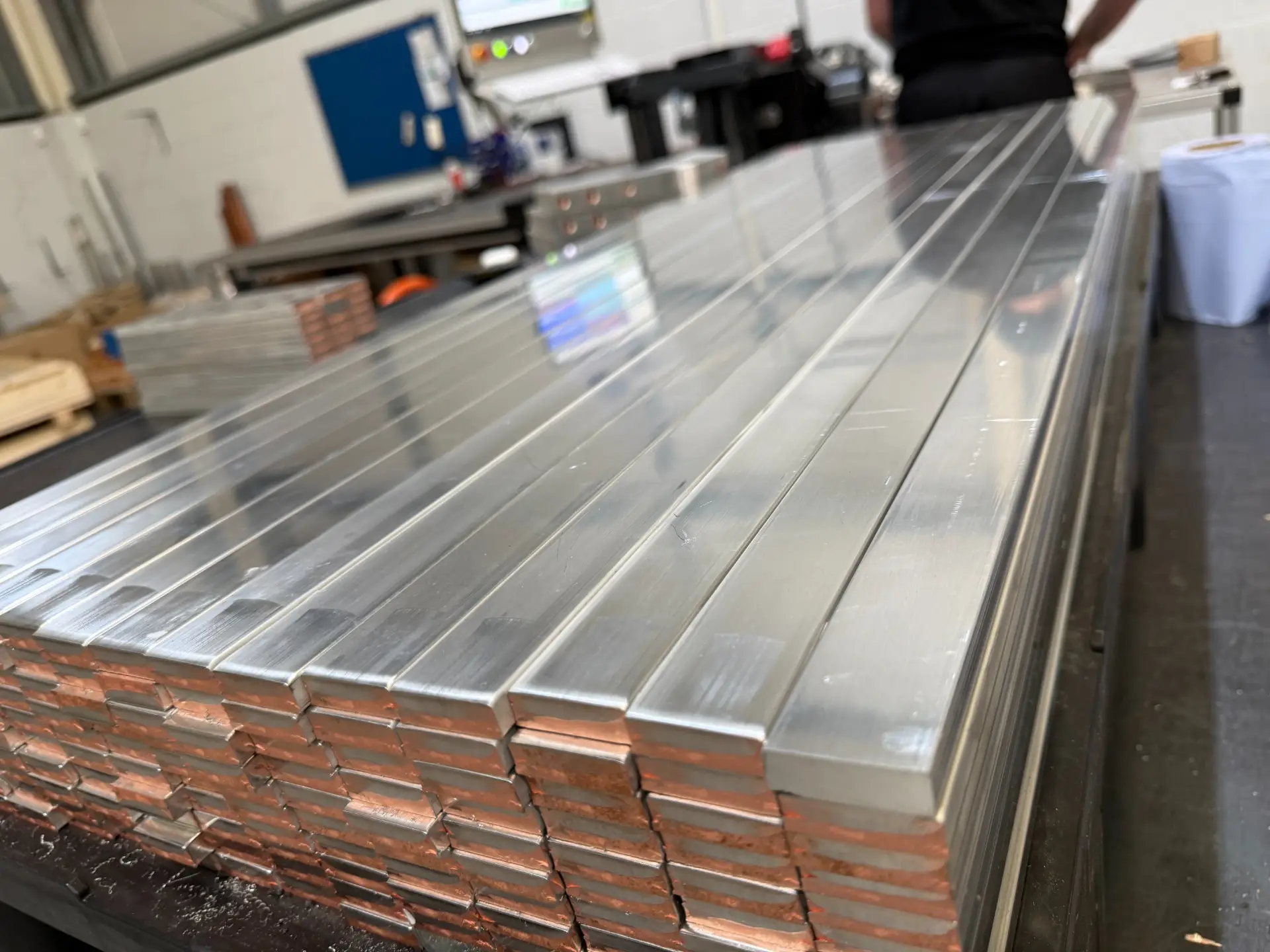
If you’re weighing up tin-plated vs silver-plated copper busbars, tin does the job at a lower cost for most fixed, bolted joints. Silver earns its higher price where joints run hot, where contacts slide or operate often, or where a switchgear design relies on the higher temperature limits that silver-coated joints are allowed. Sulphur-rich sites change the picture again, because silver tarnishes there and tin usually copes better.
Below, we compare the two finishes on contact resistance, temperature, corrosion and cost. We also look at whether you need plating at all, and what to put on your drawing so the finish you receive is the one you meant.
We manufacture copper busbars at our site in Cannock, Staffordshire, and arrange tin, silver and nickel metal plating through our plating partners, so the finish is part of every busbar job we quote.
Key takeaways
- Tin is the economical default for bolted joints that don’t move, in normal or mildly corrosive conditions.
- Silver suits hot-running joints, contacts that slide or switch often, and designs that rely on its higher permitted temperature under IEC 62271-1.
- Plating is only microns thick, so it doesn’t change a busbar’s current rating. That still comes from the copper cross-section.
- Silver tarnishes in sulphur-rich air. Pure tin can grow whiskers and wears badly where a joint moves slightly.
- Put the coating metal, minimum thickness, coverage and any undercoat on your drawing.
Why Are Copper Busbars Plated?
Bare copper is an excellent conductor, but its surface oxidises in air, and faster in damp or polluted conditions. At a bolted joint, that oxide film raises contact resistance. Higher resistance means more heat at the joint, more oxidation and, left long enough, the kind of busbar hot spots that show up on a thermal survey.
Plating protects the contact faces so the joint resistance stays stable over the life of the equipment. Depending on the metal, it can also make soldering easier, help where copper meets aluminium, and protect bars that sit in storage before installation.
Most busbar plating is electroplated, which deposits a controlled layer of metal onto the cleaned copper using an electric current. It normally goes on after cutting, punching and bending, so holes and cut edges are coated too and the finish isn’t damaged by tooling. Edges should be deburred first, because plating follows the surface it’s given and won’t hide a burr. We cover why that matters in our guide to deburring and edge finishing for busbars.
Do Copper Busbars Always Need Plating?
Not always. The Copper Development Association’s design guide, Copper for Busbars (Publication 22), takes the view that coatings aren’t generally needed from an engineering point of view, and that joint contact faces only need plating where corrosion makes it necessary. Its reasoning is that a good bare copper joint forms many tiny cold welds between the two faces. A soft plating layer can flow under bolt pressure, which over time reduces the contact pressure the joint depends on.
So a well-made bare copper joint in a clean, dry indoor panel can perform perfectly well. Plating earns its place when:
- the equipment will see humidity, condensation, coastal air or industrial pollutants
- copper is being joined to aluminium
- joints will run close to their temperature limit
- bars will be stored or shipped for a long time before installation
- The customer, panel standard or switchgear specification calls for a plated finish
If your specification calls for plating, follow it. The rest of this guide is about choosing between the two most common finishes once plating is needed.
Tin vs Silver Plating: How the Two Finishes Differ
Tin-Plated Copper Busbars
Tin is the workhorse finish for busbars. It’s relatively cheap, and it’s soft, so under bolt load it deforms into the high and low spots of the mating face and increases the real contact area. Tin does form its own oxide, but the film is thin and brittle and breaks up when the joint is tightened.
Tin also handles damp and moderately corrosive conditions well. That’s why tinned copper is a common choice in sectors such as water and waste treatment, which we mention on our busbars for panel builders page. It solders easily, and because tin sits closer to aluminium in the galvanic series than bare copper does, tinned copper is the usual choice where copper bars connect to aluminium busbars.
Tin has limits worth knowing:
- Temperature: Standards allow tin-coated joints less temperature headroom than silver-coated ones (see the table below). At sustained high temperatures, tin and copper also slowly form a brittle intermetallic layer that consumes the tin.
- Fretting: Where vibration or repeated heating and cooling cause tiny movements at a joint, often tens of microns, each movement exposes fresh tin that oxidises. The oxide debris builds up, and contact resistance creeps upwards.
- Whiskers: Pure tin coatings can grow fine conductive whiskers over time, and the Copper Development Association advises avoiding pure tin coatings for that reason. If whiskers matter in your equipment, say so on the drawing so the finish and undercoat can be chosen to limit them.
Tin’s own conductivity is only around 15% of copper’s. That sounds alarming, but the coating is a few microns thick on a bar that might be 10 mm thick, so current flows through the copper and the tin’s effect on the bar’s rating is negligible.
Silver-Plated Copper Busbars
Silver is the most conductive metal there is, slightly ahead of copper. More importantly for a joint, it doesn’t build up an insulating oxide in normal service, so contact resistance stays low and stable even when the joint runs hot. That’s why switchgear standards allow silver-coated joints the highest temperature limits, and why silver is widely used on circuit breaker and disconnector contacts that open, close or slide.
Silver can be applied to the whole busbar or only to the contact areas. Selective plating cuts the amount of precious metal, but masking adds labour, so it’s worth asking for both prices on larger runs.
Silver has its own drawbacks:
- Cost: It’s a precious metal, so it costs considerably more than tin and its price moves with the silver market.
- Sulphide tarnish: In sulphur-rich atmospheres, such as sewage and wastewater plants, paper mills, rubber processing and some chemical sites, silver forms a dark sulphide film. Light tarnish on a tight bolted joint is often cosmetic, but in polluted air the film keeps growing, and the finish loses its advantage. In these environments, tin is often the safer choice.
- Aluminium joints: Silver and aluminium sit far apart in the galvanic series, so direct silver-to-aluminium joints in damp conditions invite corrosion.
Tin-Plated vs Silver-Plated Copper Busbars Compared
| Factor | Tin-plated copper | Silver-plated copper |
| Typical use | Fixed, bolted joints in LV distribution, panel boards and busway | MV and HV switchgear joints, breaker and disconnector contacts, hot-running joints |
| Relative cost | Lower | Considerably higher |
| Conductivity of the coating | About 15% of copper, but the layer is too thin to affect the bar’s rating | Slightly higher than copper |
| Temperature limit, bolted joints in air (IEC 62271-1) | 105 °C (65 K rise) | 115 °C (75 K rise) |
| Sliding or frequently operated contacts | Wears quickly, not suited to frequent operation | Good |
| Vibration and thermal cycling | Prone to fretting corrosion | More resistant |
| Sulphur-rich environments | Generally copes well | Tarnishes |
| Joints to aluminium | Usual choice | Avoid in damp conditions |
| Main watch-outs | Whiskers, fretting, intermetallic growth at high temperature | Cost, sulphide tarnish |
What Do Switchgear Standards Say About Plated Joints?
IEC 62271-1, the common specification for high-voltage switchgear and control gear above 1 kV, sets temperature limits by surface finish. For parts in air, at an ambient temperature of no more than 40 °C, it allows:
| Part in air | Tin-coated | Silver- or nickel-coated |
| Contacts | 90 °C (50 K rise) | 105 °C (65 K rise) |
| Bolted connections | 105 °C (65 K rise) | 115 °C (75 K rise) |
Bare copper is allowed less than either. Two details in the standard are worth knowing
- A coated part only counts as coated if a continuous layer of coating remains in the contact area after the relevant tests. If the plating wears through, the joint is treated as bare, which is one reason thickness and coverage matter.
- Tin-coated parts don’t get the higher limits that other materials are given in SF6 gas, because of fretting corrosion.
These figures are the reason silver is standard in many medium-voltage designs. An extra 10 K of permitted rise at a bolted joint can mean a smaller bar or a higher rating within the same limits. Check the edition and the product standard your equipment is tested to, as the product standard can modify these values.
Low-voltage assemblies built to BS EN IEC 61439 work differently. Its temperature-rise table doesn’t give separate allowances for tin- or silver-coated busbar joints. Instead, busbar temperature is limited by factors such as the conductor material, the insulation it touches and the devices connected to it. In an LV panel, the silver case usually rests on joint performance and environment rather than a higher permitted temperature. Our guide to copper busbar sizing covers temperature rise and BS EN IEC 61439 in more detail.
How Does Plating Affect Contact Resistance?
Even a smooth-looking busbar face is rough under a microscope, so two bars only touch at many small points. Current is squeezed through those points, and that constriction is the contact resistance.
Plating changes how those points behave. Soft tin flattens under bolt load and creates more of them. Silver keeps them free of insulating oxide, even at temperature. But the coating is only one part of the joint. Contact resistance also depends on:
- clamping force, and whether it’s maintained through heating and cooling
- flatness and cleanliness of the faces
- overlap area and joint geometry
- coating thickness and coverage
- correct assembly and bolt torque
A poorly made silver-plated joint will run hotter than a well-made tin-plated one. If a joint is overheating, check the assembly before blaming the finish.
Which Busbar Plating Should You Choose?
Choose tin plating for:
- fixed, bolted joints in low-voltage distribution boards, panel boards and busway
- humid or moderately corrosive environments, including sulphur-bearing ones
- copper-to-aluminium connections
- projects where economical, reliable surface protection is the priority
Choose silver plating for:
- medium- and high-voltage busbars for switchgear, where joints are designed to the higher coated-joint limits
- circuit breaker, disconnector and plug-in contacts that see sliding or frequent switching
- high-current joints running close to their temperature limit
- compact designs where every kelvin of temperature rise counts
Consider nickel plating where hardness, wear or high-temperature stability matter more than the lowest contact resistance. See nickel plating for busbars and connectors for where it fits.
High current alone doesn’t justify silver. A correctly designed tin-plated joint often meets the electrical and thermal requirements at a much lower cost. For safety-critical equipment, follow the equipment manufacturer’s requirements and the relevant standards.
What Should You Specify on Your Busbar Drawing?
Plating problems usually start with a drawing that just says “tin plate”. To get the finish you need, include:
- Coating metal and standard: For example, ISO 2093 or ASTM B545 for tin, and BS EN ISO 4521 or ASTM B700 for silver.
- Minimum thickness in microns: There’s no single right figure. Take it from your equipment specification or design authority.
- Coverage: Whole part or selected contact faces, with any masked areas clearly marked.
- Undercoat: For example, a nickel barrier layer, if required.
- Finish type: Bright or matte, plus any requirement to limit whisker growth.
- Copper grade: Usually Cu-ETP. Our post on copper grades for busbars explains when oxygen-free copper is worth it.
- Operating conditions: Expected temperature, humidity and any contaminants such as sulphur compounds or salt air.
- Inspection: Whether you need a thickness report. X-ray fluorescence (ISO 3497) is a common non-destructive way to measure it.
Our busbar drawing checklist covers the dimensional side, including bends, hole positions and tolerances.
From Stock Bar to Plated Busbar, Through One Supplier
We hold copper and aluminium in stock and manufacture busbars at our Cannock site, covering cutting, CNC machining, EHRT punching, bending to ±0.1°, linishing and deburring. We then arrange tin, silver or nickel plating through our plating partners. You get one order and one point of contact from bar to finished, plated part, backed by our ISO 9001 and ISO 14001 certification.
Not sure which finish your joint needs? Send us your drawing and operating conditions, and we’ll talk it through with you before we quote.
Upload your drawing through our busbar design and production page, email sales@ilfproducts.co.uk or call us on 01543 226816.
Milly Edwards

Sales and Marketing Executive: Responsible for creating content for ILF's social media channels, website, print media and promotional work.